Chinese Student Marketing in the UK: 5 Trends Every Brand Needs to Understand in 2026

China remains the UK's single largest source of international students — accounting for one in every four international undergraduate acceptances through UCAS. For universities, student accommodation providers, tourism destinations, and consumer brands, this cohort represents one of the most strategically significant audiences in the country.
But Chinese student marketing in the UK is becoming significantly more complex. The decision-making behaviour of this group is changing in ways that make traditional marketing approaches — built around rankings, proximity, and brand awareness alone — increasingly insufficient.
Based on data from the New Oriental 2026 Report, here are five trends reshaping how brands need to think about reaching and engaging Chinese students in the UK.
1. The Chinese Student Market in the UK Is Larger — and More Diverse — Than Ever
The growth story is well established. What is less well understood is the structural shift happening beneath the surface.
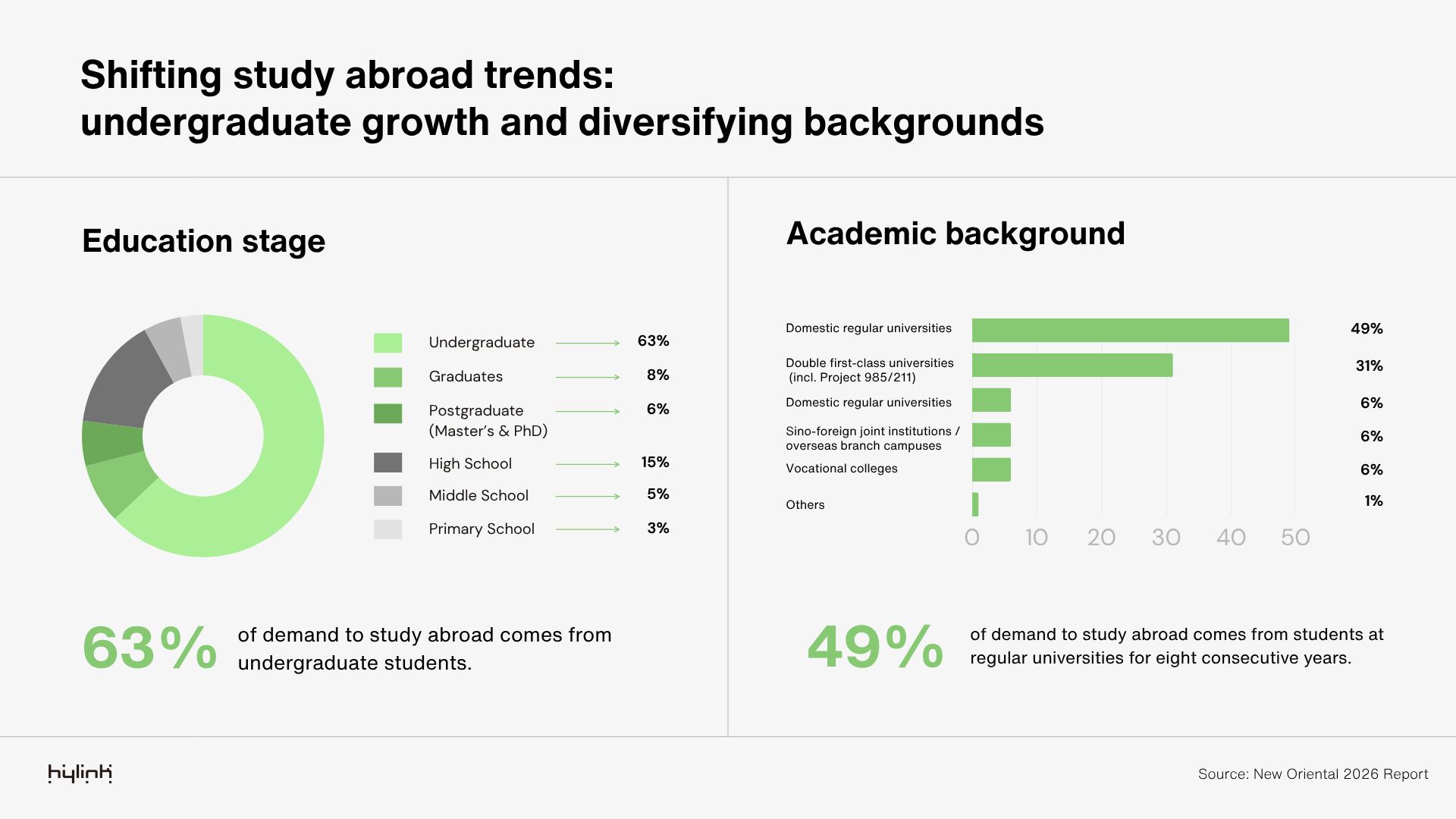
Undergraduate students now account for 63% of Chinese students studying abroad — the highest proportion in nearly 12 years. A growing share come from non-elite institutions, bringing with them different budget expectations, support needs, and decision-making influences than the postgraduate cohort that has historically dominated UK campuses.
At the same time, the UK has held its position as the top destination for Chinese students, while the US has slipped to third place and Hong Kong has risen to second for the first time — a shift driven by proximity, cost, and perceived career relevance.
For brands targeting this audience, the implication is straightforward: a strategy built around a single student profile — typically high-spending, postgraduate, Russell Group-bound — will leave a growing share of the market unaddressed. Effective Chinese student marketing in the UK now requires meaningful audience segmentation.
2. Chinese Students Are Researching Earlier — and Your Brand Needs to Be There
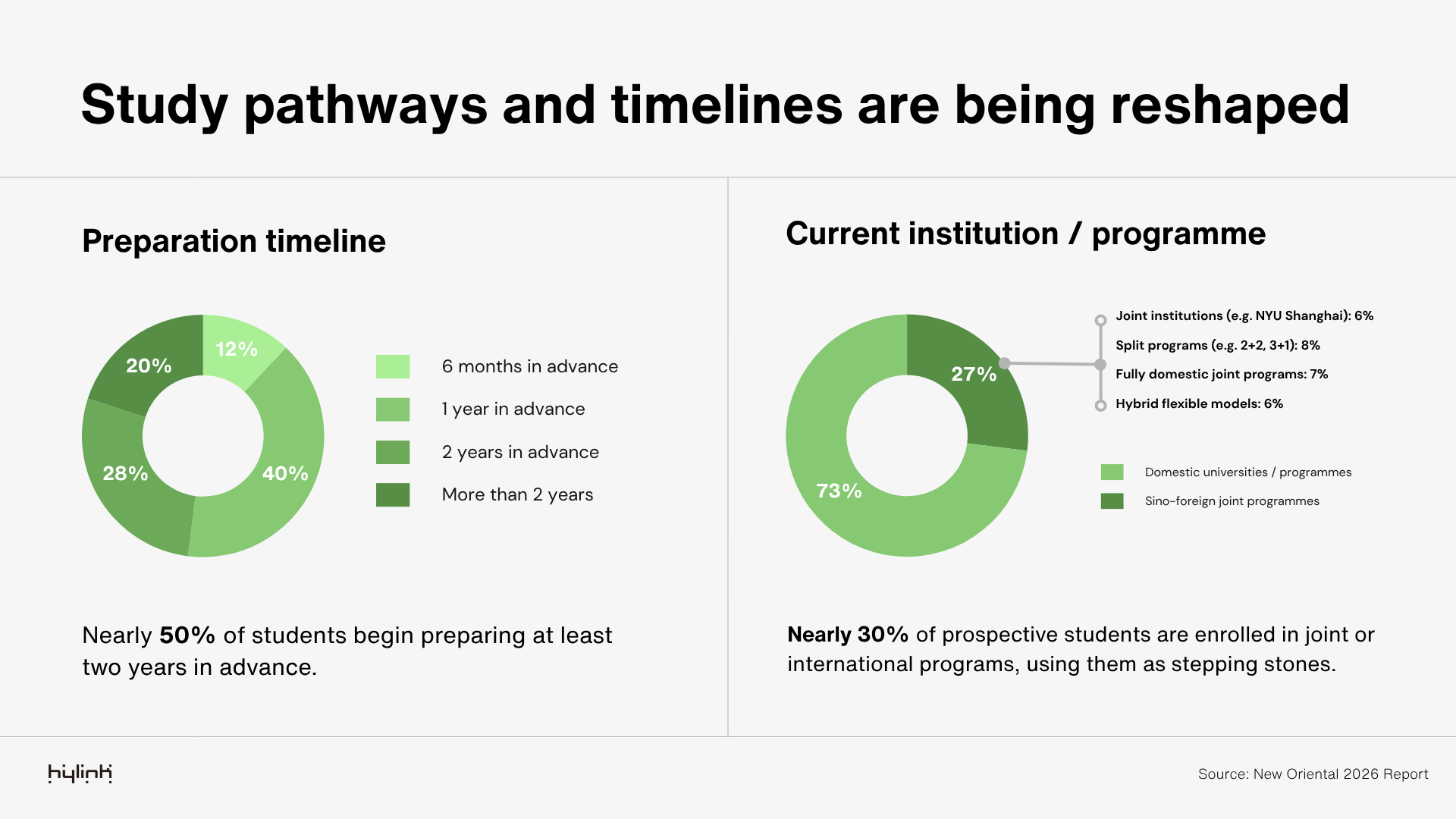
One of the most practically significant findings for anyone working in Chinese student marketing is this: nearly half of Chinese students now begin preparing for study abroad at least two years before they arrive.
This fundamentally changes the timeline for brand engagement. By the time a student receives their university offer, key preferences around institutions, cities, accommodation, and lifestyle have often already been formed — shaped through research conducted in China, via Chinese digital platforms, peer networks, and education consultants.
Research from UCAS confirms that 61% of Chinese students cite their own research as the top influencer in deciding where to study — making early-stage visibility on the right channels not a nice-to-have, but a strategic necessity. Pearson
For universities, this means recruitment marketing needs to extend well beyond the traditional application window. For accommodation providers, tourism boards, and lifestyle brands, it means that the window for influencing student perceptions opens long before students set foot in the UK.
Brands that invest early — through WeChat, Xiaohongshu, education agent partnerships, and always-on content — are building pipeline that late-entry competitors simply cannot replicate.
3. Chinese Students Are Evaluating Everything Through a Return-on-Investment Lens
The most fundamental shift in Chinese student decision-making is the move from prestige-led to return-on-investment-led thinking. Students — and the families who fund them — are approaching study abroad as a long-term financial investment, and applying the same scrutiny to every associated choice.
Research from HEPI highlights that Chinese students find it significantly harder than other international students to find post-study employment in the UK — a reality that is sharpening the focus on outcomes and making career support a genuine differentiator for institutions. HEPI
For universities, this means institutional reputation alone is no longer sufficient. Graduate employment rates, scholarship availability, and demonstrable career pathways are becoming central evaluation criteria.
For student accommodation brands, it means students are asking harder questions about what they are getting for the premium. For tourism destinations and experience providers, it means aspirational messaging needs to be grounded in genuine, relatable value — not just visual appeal.
Across all sectors, Chinese student marketing that leads with image and prestige needs to be balanced with clear, evidence-based value communication.
4. Peer Recommendations and Chinese Social Platforms Drive the Decision Journey
In an environment where students are conducting thorough, multi-source research well in advance of any decision, peer credibility has become one of the most powerful forces in Chinese student marketing.
Research confirms that Chinese students studying in the UK continue to use Chinese social media — including WeChat, Weibo, and Xiaohongshu — rather than migrating to Western platforms like Instagram. This means that brand visibility on Chinese platforms is not optional for organisations that want to reach this audience where they actually spend their time.
Reviews, community-driven content, and firsthand accounts from current or former students carry substantial weight — whether a prospective student is evaluating a university, choosing accommodation, or deciding whether to visit a destination.
Polished marketing assets are a baseline, not a differentiator. Organisations that build genuine relationships with Chinese student communities — and create conditions for authentic advocacy — will have a competitive advantage that paid media alone cannot replicate. Student ambassador programmes, Xiaohongshu content strategies, and WeChat community management are increasingly central to effective Chinese student marketing in the UK.
5. Flexible Study Pathways Are Creating an Underserved and Fast-Growing Audience Segment
The growing popularity of 2+2 and 3+1 joint degree programmes and Sino-foreign cooperative models is generating a cohort of students whose journey looks quite different from the traditional full-degree international student pathway.
These students may arrive mid-year, spend only part of their studies in the UK, or have significantly less familiarity with British institutions when they arrive. Current marketing and communications strategies — built around a standard full-degree experience — frequently leave this group underserved.
China is already the UK's largest undergraduate global market, accounting for one in every four international acceptances through UCAS. As flexible pathways grow within this number, brands that develop specific propositions and communications for this segment — including Mandarin-language support, flexible terms, and tailored onboarding — will have a meaningful edge. UCAS
What This Means for Your Chinese Student Marketing Strategy
Chinese students are not simply adapting their behaviour incrementally. They are reshaping the expectations they bring to every brand interaction — and raising the bar for what effective marketing in this space actually requires.
The brands and institutions that will build lasting relationships with this audience share a common approach: they understand how the decision-making journey actually works, they are present on the right channels at the right time, and they communicate value in terms that resonate with how this cohort actually thinks.
That means earlier engagement, stronger presence on Chinese digital platforms, clearer outcome-led messaging, and a willingness to move beyond generic international student marketing towards strategies that reflect the real complexity of this audience.
At Hylink, we specialise in Chinese student marketing for UK universities, accommodation providers, tourism destinations, and consumer brands — helping organisations build strategies that work across the full decision-making journey, from awareness in China to conversion and retention in the UK. To explore what that could look like for your organisation, get in touch at hello@hylink.co.uk.