If UK destinations are not appearing on RED, they are not entering consideration

How Chinese travellers are discovering, evaluating and planning UK trips differently
1. The Chinese market is back — but the decision-making has changed
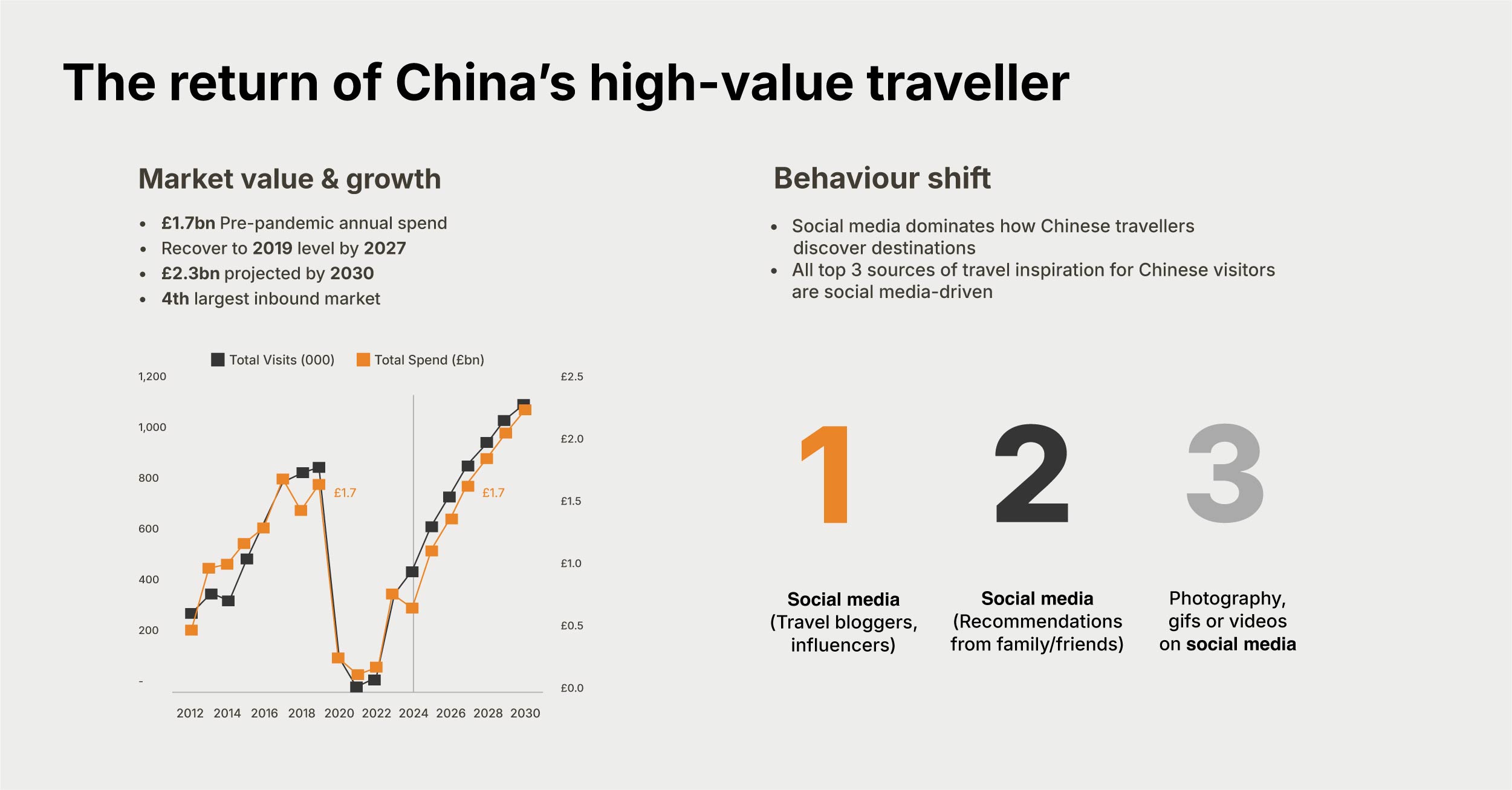
China remains one of the UK's most valuable inbound markets. Before the pandemic, Chinese tourists contributed approximately £1.7 billion to UK annual spending. Spending is projected to reach £2.3 billion by 2030, making it the UK's 4th most valuable inbound market. The scale of the opportunity is clear.
But the way Chinese tourists decide where to go has fundamentally shifted. According to a 2023 report by Topklout, over 80% of Chinese travellers consult online platforms when planning trips. For Chinese travellers, social platforms are no longer supplementary channels — they are becoming part of the travel planning infrastructure itself. They are the starting point for discovery, research, and decision-making.
The question is no longer “how do we reach the Chinese market?” It is “how do we appear where travel decisions are actually being made?”
2. Choosing the UK is a high-consideration decision
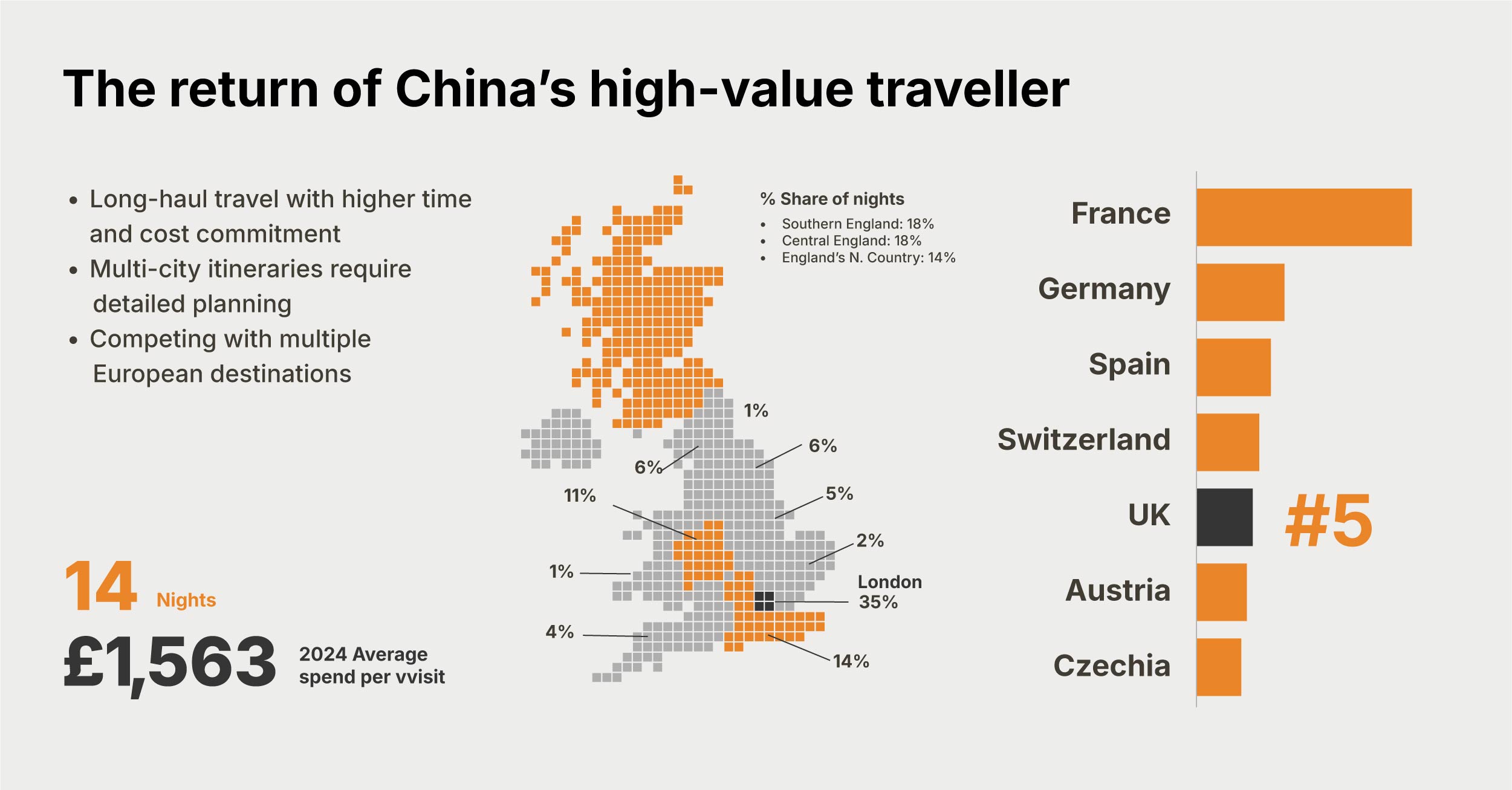
A UK trip is not a casual decision for a Chinese traveller. It involves a visa, long-haul flights, higher costs, and a complex itinerary that typically extends well beyond London — multiple cities, regional destinations, and a sequence of experiences that each need to earn their place. The higher the investment, the more thoroughly users research before committing.
This is also a competitive market. France, Italy, and Germany offer comparable cultural appeal at similar price points. In a high-consideration market, broad awareness alone does not win decisions, what shifts decisions is content that reduces uncertainty and helps travellers visualise how the trip will actually work.
3. RED's distinct role in the discovery process
Not all platforms function the same way. In China's social media ecosystem, short video platforms optimise for entertainment, and messaging apps serve existing social networks. RED (Xiaohongshu) has developed a different kind of content ecosystem — one built around lifestyle discovery and peer-sourced guidance.
Travel content on RED is characteristically specific. Users don't just post about a destination — they share complete experiences: itineraries, time allocations, restaurant reservations, queue conditions, cost breakdowns, and candid assessments. This is the level of detail a potential visitor actually needs to make decisions.
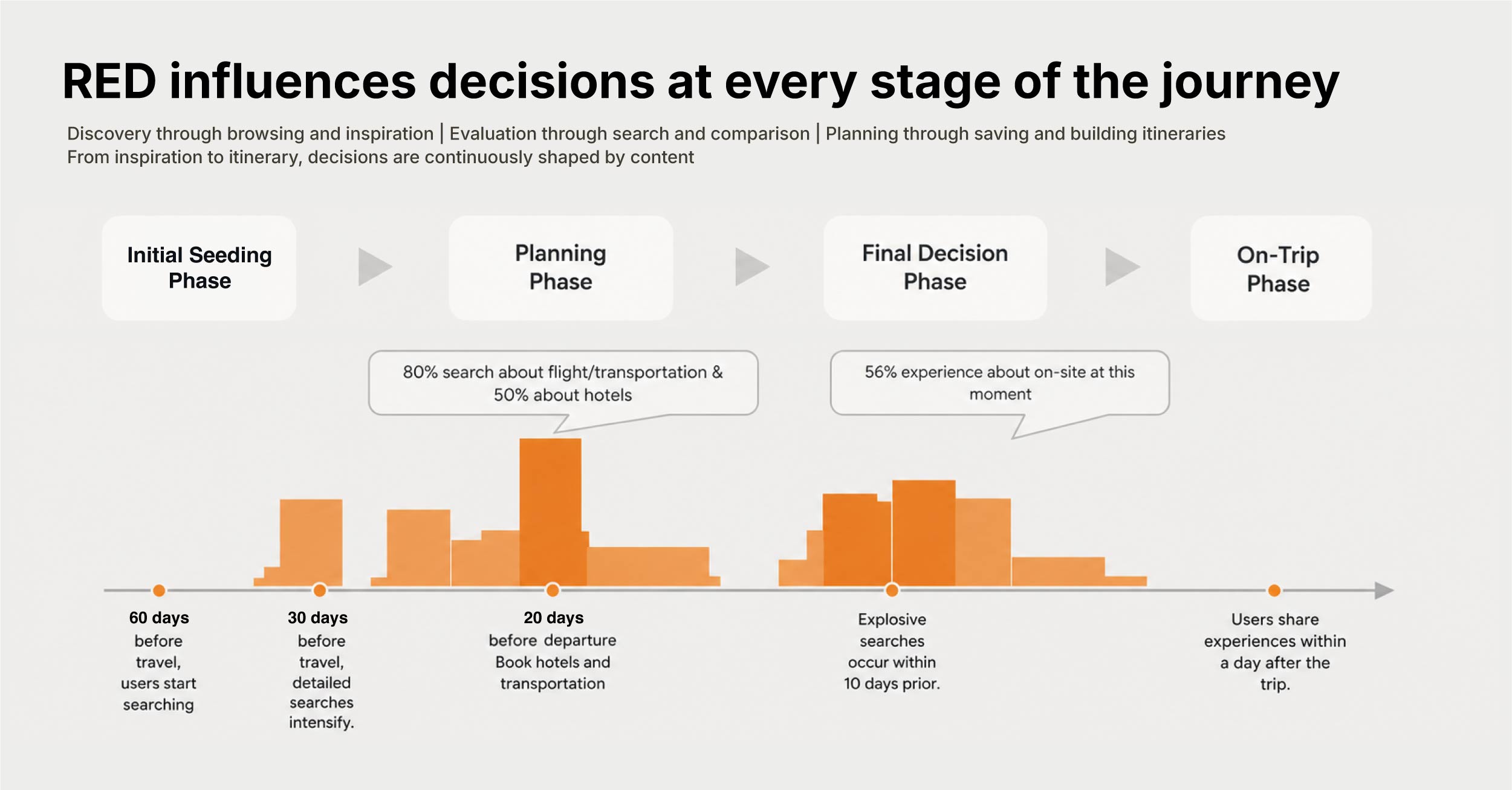
Chinese travellers no longer separate inspiration from planning. Both now happen simultaneously on RED. The result is a platform that serves two distinct functions simultaneously. It drives initial inspiration — a user browses RED and encounters a neighbourhood, a restaurant, or a regional destination they hadn't previously considered. And it drives active evaluation — when a user has shortlisted options, they return to RED to stress-test their choices. Both stages happen on the same platform, often in the same session.
For UK destinations, this dynamic matters enormously. A destination that appears consistently in RED’s content ecosystem is being considered. One that doesn’t appear is being overlooked — regardless of how strong its brand is elsewhere.
In practice, a user might first encounter a destination area through a browsing post, then return to search for specific restaurants and routes, then save content from multiple notes to build their itinerary piece by piece. Each post has the potential to become a confirmed stop. Discovery on RED is not a linear funnel.It is an ongoing loop of influence, validation and itinerary-building.
4. What this means for UK destination marketing
In our work managing RED as the primary content channel for London Destinations, the practical implication is clear: presence on the platform is necessary, but it is not sufficient. What determines whether content actually gets found — and acted on — is how it is structured.
RED’s AI search system indexes content based on structured information, not just keywords. Notes that include a consistent set of elements — venue background, location and access, price reference, signature dishes or key products, best visiting scenario, and a highlights summary — are significantly more likely to be surfaced in both user searches and AI-generated recommendations.RED is increasingly functioning as a searchable recommendation infrastructure — not simply a social platform. This is not a creative preference; it is how the platform’s retrieval logic works.
Producing content in this format also builds a reusable asset library over time. Each structured note becomes a long-term, retrievable reference — not a post that fades after a week. For destinations managing multiple venues or experiences, this compounds: the accumulated content body increases overall discoverability across the portfolio, not just for individual posts.
RED rewards specificity and structure, not volume. A smaller body of well-formatted, information-dense content will consistently outperform a high volume of generic posts. For destinations serious about the Chinese market, that requires understanding how the platform actually works — success on RED is no longer just about publishing content.
It is about building content structured for discoverability, retrieval and recommendation.